
Polyurethane Wheels
Standard wheels debond, mark floors and wear out. Custom-engineered polyurethane wheels keep rolling.
— The Recurring Problems
Flat-spotting
Load-bearing wheels take a set when parked or stopped under load, because rubber takes a set and goes out of round, adding vibration, noise and lost traction
Debonding
Injection-molded plastic wheels debond from their metal cores under sustained load
Traction
Drive wheels need traction and dimensional stability at speed without slipping or marking
Wear
Continuous-duty wheels wear and raise push-pull force, noise and maintenance
No-crush
Fragile product handling needs gentle, no-crush contact, and premium surfaces can’t be marked
System Fit
Each application needs its own durometer, traction and geometry a catalog wheel can’t provide
— The Differentiator
Where standard components fall short
Most engineers start with standard rubber wheels, injection-molded plastic wheels, or metal wheels. Each one falls short:
- Rubber can take a set, squeak and lose roundness, and injection-molded plastic can debond from its core
- Plastic and metal wheels run noisy, grip poorly and can mark the surface
- Worn wheels raise push-pull force, impacting system reliability and maintenance costs
- None can be customized to the load, durometer, traction and geometry the system requires, and stock suppliers offer no engineering support
— Solution Spotlights
How MPC solves it | A wheel customized to load, traction and geometry
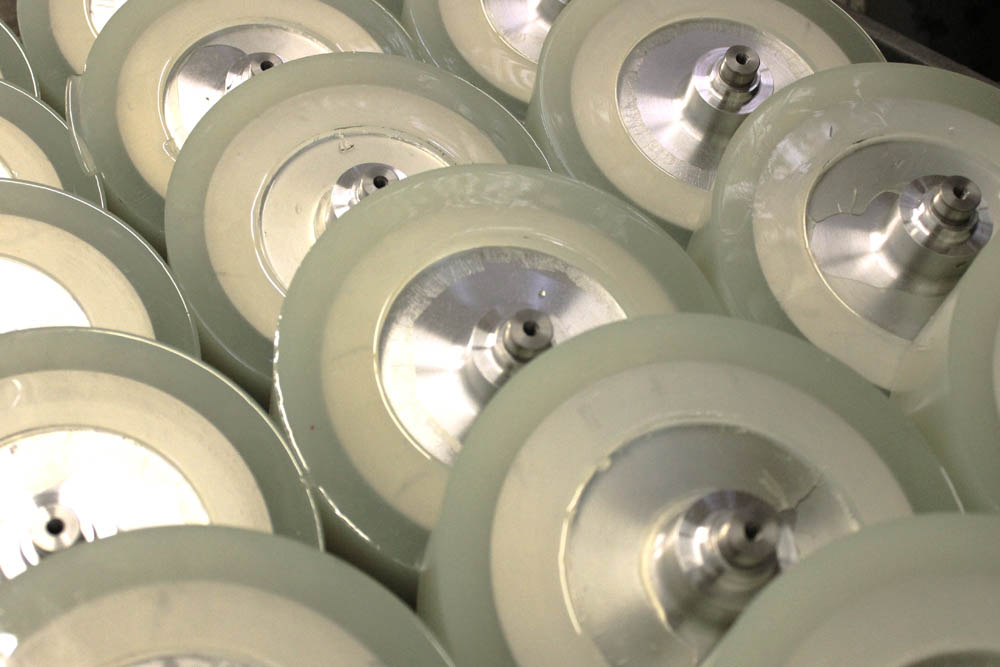
Every MPC wheel is custom-engineered. MPC manufactures custom-cast polyurethane wheels and casters, customized to the load, durometer and traction needs of the application and chemically bonded to a machined core.
Flat-spotting
Low compression set, so the wheel holds its roundness and doesn’t take a set when parked under load, where rubber takes a set
Debonding
The tread-to-core bond is chemical and stronger than the polyurethane itself, which removes the debonding that fails molded plastic
Traction
Cast polyurethane customized to the load and traction the drive needs, quiet and non-marking, holding dimension at speed
Wear
Long wear life keeps push-pull force, noise and rolling resistance down over continuous duty
No-crush and static
Low-durometer no-crush wheels for fragile product, and static-dissipative or conductive wheels where static buildup must be controlled
Dual-durometer and service
Dual-durometer construction when the position needs both a soft tread and a hard hub

Talk it through with a polyurethane expert who’ll tell you what’s achievable and what is not.
— featured case study
Custom Casters Eliminate Flat-Spotting on a Medical Imaging OEM's Equipment
A global medical-imaging OEM was losing equipment uptime to casters that set under load. This case study shows how MPC identified compression set as the root cause and delivered a custom caster that eliminated the problem and met the equipment’s lifecycle requirement.
A global medical-imaging OEM’s casters were taking a set, which drove equipment downtime, customer complaints and lost sales.
MPC identified compression set as the root cause and delivered a custom caster engineered to eliminate the issue.
THE RESULT
that caused customer complaints
Met the equipment’s lifecycle requirement

— Technical Specifications
The specs that matter
Property
Range for this solution
Hardness
ASTM D2240
- Shore 20A–70D — solid polyurethane
- Customized per part
Mechanical properties (Durethane® S)
- Tensile strength 250–7,800 PSI
- Tear strength, Die C 30–800 PLI
- Elongation 160–850%
- Compression set 5–40%
Heat, aging, hydrolysis and chemical resistance (Durethane® XL)
- Shore 70A–90A
- Tensile strength 3,000–5,000 PSI
- Tear strength, Die C 225–375 PLI
- Compression set 17–20%
Volume resistivity (Durethane® C)
- Conductive range ≈ 10⁵–10¹¹ Ω-cm
- Typical ESD dissipation target 10⁶–10⁸ Ω-cm, held part to part
Abrasion and surface finish
High abrasion resistance with tolerance to tight surface finishes
Customizable properties
- Hardness, tensile, tear and compression set are formulated to the part
- Cast onto machined metal cores and hubs; the bond is chemical and stronger than the polyurethane itself
- Dual-durometer construction available
- Tread profile, crown and width customized to the load
Relevant technical downloads
Document
What it gives the engineer
Polycarbonate polyurethane material specifications.
Conductive polyurethane material specifications, including the volume resistivity range.
Solid polyurethane material specifications: hardness 20A–70D with tensile, elongation, tear and compression set.
In-depth overview of MPC’s patented metal salts technology, which provides stable volume resistivity as the part wears.
— Industry highlights
Where this product works
MPC seals and gaskets contain fluid, gas and pressure across industries. These are examples, not limits:
Custom sealing elements for leak-test tooling, less permeable to helium than rubber for repeatable tracer-gas results
Downhole and high-pressure seals, valve seats and mud-pump pistons for HPHT, abrasive service
Seals in wash-down and product-adjacent equipment, with FDA-compliant formulations where product contact requires. Not commodity food-lid seals
— HOW IT WORKS
From concept to scaled production
Connect With Us
Share your application, performance needs, or a part you want to improve.
Collaborate on Design
Our engineers will help optimize materials and geometry for manufacturability.
Prototype & Refine
We produce samples using our proprietary polyurethane formulations for testing.
Move to Production
Once approved, we move to scalable molding with full quality assurance.
Tell us the load, surface, speed and environment, and MPC will engineer build your wheel or caster to your exact specifications.
— PROOF
Case studies & white papers
Case Studies
Automation OEM Launches Cleanroom Robotics On Schedule
An automation OEM needed cleanroom-rated wheels that were also tough enough to last. This case study shows how MPC developed a custom conductive wheel that met the ISO cleanliness requirements with extended wear life and validated the part in time to keep the customer’s launch on schedule.
Robotics OEM Doubles Roller Life, Boosts Uptime
A continuous-duty robotics manufacturer kept losing rollers to flatspotting under constant load and start-stop motion. This case study shows how MPC’s custom cast roller eliminated the flat spots and delivered about 2× the service life, cutting the unplanned maintenance that was slowing the line.
White Papers
Engineering Urethane Wheels and Rollers for Robotics and Automation
Wheels and rollers are among the hardest-working parts in any automated system. This white paper walks engineers through designing them for load, wear, traction, and reliability in heavy-duty robotics, so they last instead of becoming the weak link.
Engineering Polyurethane Components for Heavy-Duty Applications
Modern automation pushes mechanical parts past what standard materials can handle. This white paper covers the material, process, and design choices behind heavy-duty polyurethane components for robotics and precision systems, so they hold up under continuous duty.
— Design Guide
How to specify a custom polyurethane wheel or caster, plus the load, compression-set and bonding factors that matter.
— FAQ
Frequently Asked Questions
What wheel or caster material stops flatspotting under continuous load?
A custom cast polyurethane wheel with low compression set. It holds its roundness when parked or stopped under load, so it doesn’t take a set the way rubber does.
How do I keep the wheel tread from debonding from the metal core?
Use a chemically bonded polyurethane wheel. MPC’s polyurethane bond to its core is stronger than the polyurethane itself, so the tread doesn’t debond under sustained load the way injection-molded plastic can.
What rolls quieter and lasts longer than rubber?
Custom cast polyurethane. It rolls quietly and non-marking, holds its roundness instead of taking a set, and lasts longer under continuous duty, so push-pull force and noise stay down.
What is a no-crush wheel, and how does it handle fragile media?
A no-crush wheel is a low-durometer wheel that spreads its contact and cushions the load, so it carries or moves fragile product without crushing or marking it. MPC customizes the durometer to your specifications.
Can wheels be conductive or ESD-safe?
Yes. MPC makes static-dissipative and conductive wheels customized to an ESD-dissipating volume resistivity, for lines where electrostatic charge has to be controlled.
Do you make standard wheels, or is every wheel custom?
Every MPC wheel is custom-engineered. There is no off-the-shelf catalog wheel; each one is customized to the exact needs of your application.
— Keep Exploring